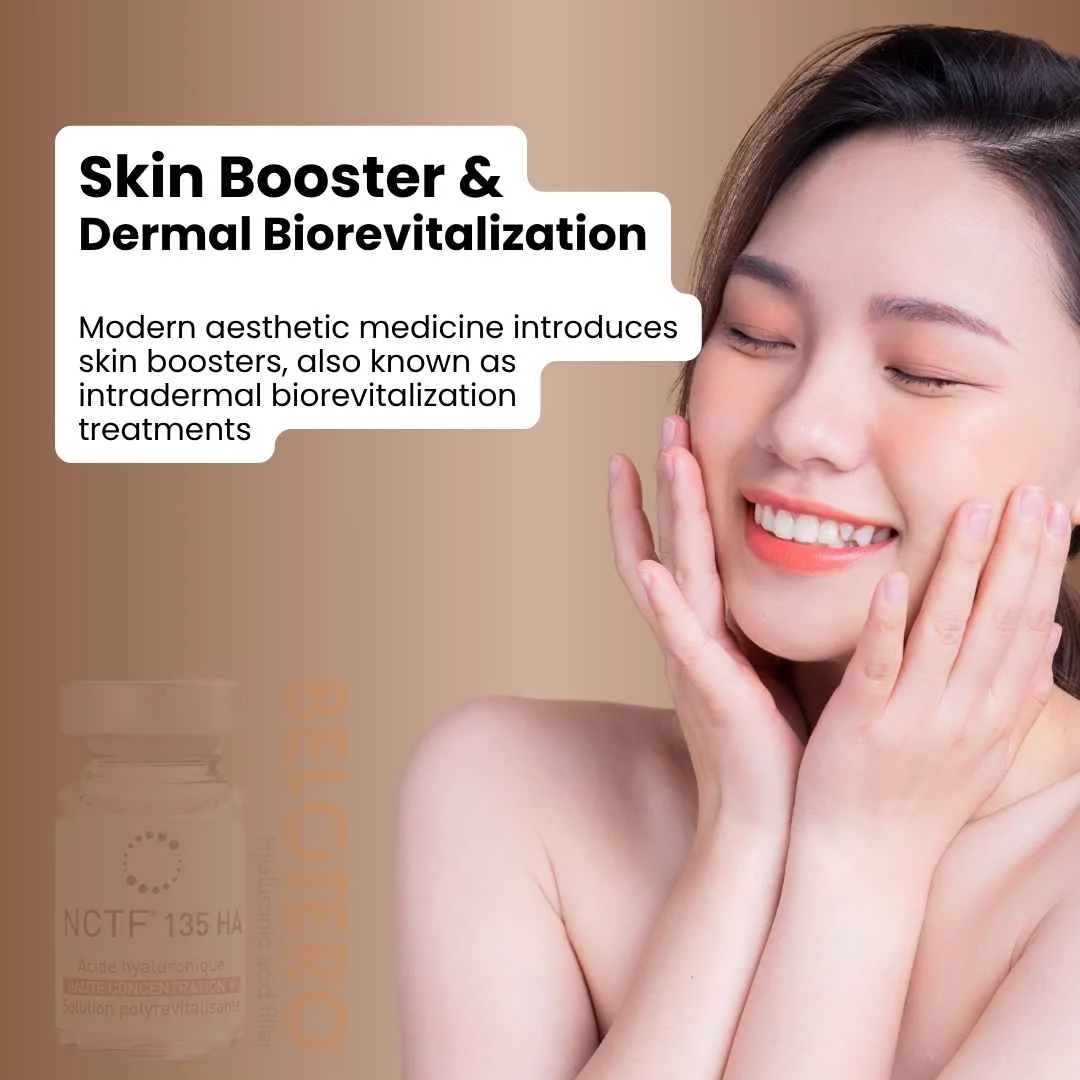
In this respect, contemporary aesthetic dermatology brings skin booster, or intradermal biorevitalization therapies, which provide scientific approach to skin rejuvenation from inside out.
Often, obtaining well-hydrated skin is not sufficient just by applying products topically. Although the moisturizers and active ingredients help to keep your skin barrier intact, there is a limitation of their deep absorption into the underlying dermis layer where collagen and elastin reside and where structural aging takes place.
Skin boosters are quite different from dermal fillers that can change facial contours by filling the wrinkles and restoring volume. Skin boosters have been developed to improve the hydration and elasticity of the skin without changing its appearance.
How Skin Booster Work?
The mechanism of action of skin boosters involves their interaction with the extracellular matrix (ECM), which is the supporting structure of the dermis made of collagen, elastin, and proteoglycans.
As people age intrinsically and suffer from prolonged exposure to ultraviolet radiation, the activity of fibroblasts becomes diminished, leading to low production of collagen, elastin, and endogenous hyaluronic acid. It causes dehydration, development of fine lines, loss of elasticity and skin thinning.
Skin boosters are able to compensate these adverse processes in two main ways:
- Deep Dermal Hydration
Due to high hydrophilicity and ability to bind water, hyaluronic acid can make the superficial and mid-dermis hydrated, elastic, and better reflecting the light.
- Supporting Dermal Remodeling
Apart from providing the skin with hydration, injection of HA into the dermis can positively influence the process of fibroblasts functioning by creating an appropriate microenvironment for them.
Comparing Leading Skin Booster and Bioremodulators (The Next Step in Skin Regeneration)
Bioremodulators go a step beyond standard skin boosters. Rather than only hydrating the dermis, they are designed to signal the skin’s own cells to repair and renew themselves, supporting collagen, elastin and overall tissue quality. The most popular options are, NCTF, Profhilo, Juvelook and Salmon DNA.
NCTF
Poly-revitalizing solution that combines hyaluronic acid with more than 50 active ingredients, such as amino acids, vitamins, coenzymes, and nucleotides. The goal of these ingredients is to help with cell metabolism and to serve as substrates for dermal repair.
Profhilo
Profhilo is an injectable hyaluronic acid (HA) bioremodulator with one of the highest HA concentrations available in an injectable. It combines high and low molecular weight HA, stabilized using a thermal process (NAHYCO® technology) without chemical cross-linking.
How it works: After injection, Profhilo spreads gradually through the tissue instead of staying in one place. It hydrates the skin, improves laxity and stimulates the production of collagen and elastin.
Best for:
- Loose or lax skin on the face, neck and décolletage
- Dehydrated, thin or dull skin
- Early signs of aging, without added volume
Juvelook
Juvelook is a Korean-developed regenerative treatment that combines poly-D,L-lactic acid (PDLLA) with hyaluronic acid. It works in two ways: the HA provides immediate hydration, while the PDLLA acts as a biostimulator, encouraging the skin to produce its own collagen over time.
Best for:
- Fine lines and wrinkles
- Crepey, thinning or sagging skin
- Enlarged pores and uneven skin texture
- Loss of firmness and elasticity
Salmon DNA (PDRN / Polynucleotides)
Salmon DNA treatments use PDRN (polydeoxyribonucleotide) or polynucleotides, purified and highly refined DNA fragments derived from salmon. They are best known through treatments such as Rejuran. These molecules are biocompatible with human tissue and support the skin’s natural repair processes.
How it works: Salmon DNA is thought to stimulate fibroblast activity, improve cell regeneration, support healing, and reduce inflammation, helping to restore skin quality at a cellular level.
Best for:
- Thin, fragile or damaged skin
- Under-eye areas with fine lines and dullness
- Acne scars and uneven texture
- Sensitive skin that needs repair and calming
- Overall skin quality and glow
Which Treatment Is Right for You?
| Treatment | Primary Action | Ideal For |
|---|---|---|
| Profhilo | Deep hydration and skin tightening | Skin laxity, dehydration |
| Juvelook | HA hydration plus collagen stimulation | Fine lines, texture, firmness |
| Salmon DNA | Cellular repair and regeneration | Thin, damaged or scarred skin, under-eyes |
The right choice depends on your skin condition, age, goals and medical history. These treatments can also be combined as part of a personalized skin rejuvenation plan. A consultation with a qualified aesthetic doctor is the best way to decide.
Clinical Indications
Skin boosters are versatile and suitable for a wide range of indications, including:
- Dehydrated, dull or tired skin
- Early signs of photoaging and loss of elasticity
- Superficial fine lines and wrinkles
- Sensitive areas such as neck, décolletage and hands
Protocol for Treatment and its Effectiveness
Skin boosters are applied through microinjections with fine needles or mesotherapy guns. This treatment is usually well-tolerated by patients, with very little downtime required. Any papules and erythema will usually subside within 24-48 hours after the procedure.
Often, patients will notice immediate results in the form of improvement in hydration and radiance; skin texture and elasticity will improve gradually over weeks.
A commonly recommended protocol includes:
- Initial regimen with 2-3 sessions spaced 3-4 weeks apart each
- Maintenance every 6-9 months
A Regenerative Approach to Skin Quality
Rather than providing temporary surface correction, skin boosters represent a shift toward biological skin enhancement, focusing on hydration, dermal support, and long-term skin quality improvement.
For patients seeking natural-looking rejuvenation without added volume, intradermal biorevitalization offers a clinically effective and increasingly popular solution.